

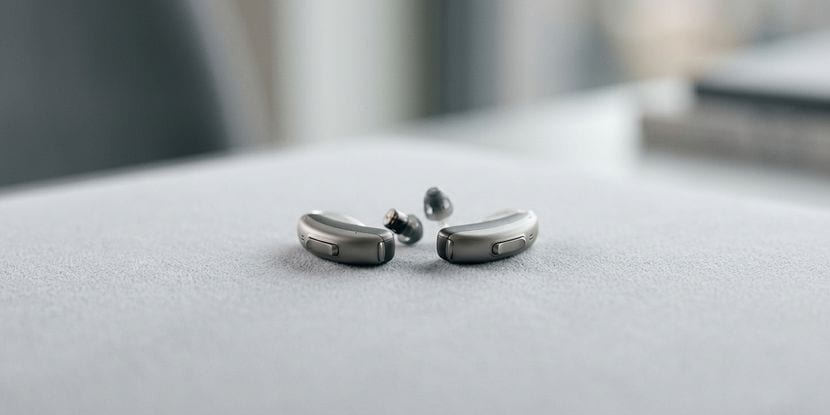
The hearing aids with noise cancellation help you follow a conversation when the environment sounds louder than the person in front of you. In a crowded restaurant, on a street with traffic or in a meeting with many people, hearing does not always mean understanding, and the effort to distinguish words ends up being tiring.
Noise cancellation in hearing aids: how does it work?
Reducing background noise does not depend on a single mechanism. Hearing aids combine two systems that act at different times and complement each other so that speech reaches you with greater clarity.
- Passive cancellation: depends on the physical design of the hearing aid. When the earmold or dome fits well in the ear canal, it acts as a barrier that blocks part of the outside noise before it reaches the ear.
- Active cancellation: depends on the processor. The microphones pick up the sound from the environment and the chip identifies constant noise, such as the engine of a car or the murmur of a venue, and attenuates it. Speech is maintained and is less tiring to follow.
Tips for choosing hearing aids with noise cancellation
The best option is not the one that includes the most functions, but the one that responds to how you hear and where you need to hear better. These points help you make an informed decision.
1. Choose according to how you use them and your lifestyle
Before comparing models, identify the moments when you find it most difficult to follow a conversation: at work, watching television at home or during family meals.
If your schedule includes meetings, events or travel, you will need a system that changes environments quickly. If your routine is quieter, a simpler model may meet your needs without resorting to a high-end range that you would barely take advantage of.
2. Opt for technology that adapts to your hearing loss with professional fitting
The processor alone does not solve anything if it is not configured for your hearing. An incorrect fitting can attenuate sounds that you do need to hear, such as a warning or a voice calling you. That is why the hearing care professional programs the noise reduction according to your audiometry and adjusts each parameter until the environment is softened without losing speech clarity.
3. Check that the hearing aid adapts well to the shape of your ear
The physical fit directly influences passive cancellation and comfort. These are the aspects that should be checked during the trial:
- Proper sealing of the ear canal, without pressure or discomfort.
- Comfort when wearing them for several hours at a time.
- Stability when speaking, chewing or turning your head.
- Natural sound of your own voice, without a feeling of echo or muffling.
4. Test performance in real sound environments before deciding
A quiet consultation does not reflect what will happen on the street or in a bar. It is advisable to try the hearing aids in everyday situations and return for a follow-up to fine-tune them. Pay attention to these signs during the trial period:
- Better understanding of your conversation partner in noisy places.
- Less hearing fatigue at the end of the day.
- Important sounds, such as traffic or the doorbell, that remain audible.
- Less need to turn up the volume.
Hearing aids with noise cancellation in Málaga
At Centro Auditivo José Luis Domínguez, we assist people with hearing loss and focus on helping each person find the solution that fits their day-to-day life. If you are considering hearing aids with noise cancellation, we start with a free hearing check to find out how you hear, in which situations you find it most difficult to follow a conversation and what you expect from your hearing aids. With this information, we explain the available options and test them with you so that you can compare the real experience.
Our work continues after delivery. We accompany you during the adaptation period, review how the hearing aid responds in the environments you frequent most and adjust the cancellation parameters when necessary.
If you are looking for hearing aids in Málaga with a team that is involved at every step, request your appointment.
Sources and references
- NIDCD / National Institutes of Health — Hearing aids: cómo funcionan los audífonos digitales y los micrófonos direccionales
- NICE — Hearing loss in adults: assessment and management (NG98)
- FDA — Medical Devices; Ear, Nose, and Throat Devices; Establishing Over-the-Counter Hearing Aids
- Journal of the Acoustical Society of America / PubMed — Active cancellation of occlusion: an electronic vent for hearing aids and hearing protectors

Audiólogo y administrador del Centro Auditivo José Luis Domínguez. Formado en Audiología Protésica en el IES Santa Bárbara de Málaga, forma parte del equipo desde 2017.