

In a healthcare consultation, it is quite common for someone to arrive saying that they have been “hearing less” for some time without really knowing when it started. In many of these cases, hearing loss is not noticed suddenly but rather develops gradually: the television volume is turned up, people ask others to repeat themselves during conversations, or it becomes difficult to follow a discussion in noisy environments. When this happens, one of the first tests usually recommended to understand what is going on is an audiometry test.
What is an audiometry test?
Audiometry is a test used to measure a person’s ability to hear different sounds. Specifically, it determines the sound intensity each ear requires to detect tones at different frequencies. Put simply, it helps assess how well a person can hear and whether there is any degree of hearing loss.
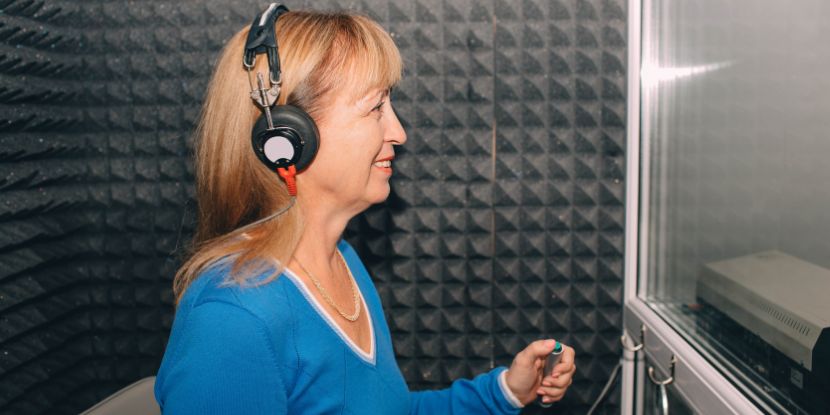
It is not an invasive or painful test. It is normally carried out in a booth or room isolated from outside noise so that the measurements are as accurate as possible. During the examination, the person must indicate when they hear certain sounds, which may vary in tone and intensity. With this information, the specialist obtains a kind of “map” of the person’s hearing.
Audiometry is not only used when hearing loss is already suspected. It is also useful as a monitoring tool for people who work in noisy environments, during routine check-ups, or when there is a history of ear-related problems. In addition, it helps determine whether the issue is located in the outer, middle, or inner ear, which is important when deciding on the most appropriate treatment or solution.
Audiometry step by step: How it works
Although it may seem like a complex test, the audiometry process is quite structured and always follows a series of steps. The goal is to ensure that the results are reliable and comparable.
Patient preparation
Before starting, the professional usually asks a few questions about hearing, recent discomfort, ear infections, or exposure to loud noises. This part is important because it helps put the results into context. Afterwards, the person puts on special headphones and enters a quiet environment or a soundproof booth.
In most cases, no special preparation is required beforehand. It is enough to attend as normal, although it is recommended to avoid exposure to very loud noises immediately before the test so as not to temporarily affect hearing.
Presentation of pure tones
Once the patient is ready, sounds at different pitches and volumes begin to be played. These sounds are sent separately to each ear. The person must indicate every time they hear a tone, usually by pressing a button or raising a hand.
This step is essential because it allows the specialist to determine the hearing threshold, meaning the lowest level at which each ear begins to perceive sound. It is repeated several times using different frequencies to obtain a complete assessment.
Evaluation of sound conduction
In some cases, bone conduction tests are also performed. This means that sound is transmitted through vibrations in the skull bone, helping to determine whether the problem is located in the outer or middle ear or whether it affects the inner ear.
This part is important because not all types of hearing loss have the same cause, and this type of measurement helps refine the diagnosis.
Speech audiometry
Another common part of the assessment is speech audiometry, where words are used instead of tones. The patient must repeat what they hear. This helps evaluate not only whether sounds can be heard, but also whether they can be understood correctly.
In everyday life, this is essential because many people do not have as much difficulty hearing a sound as they do understanding it during real conversations, especially when there is background noise.
Interpretation of results
Once the test is completed, the specialist analyses the data collected and displays it on a graph called an audiogram. This makes it possible to clearly see whether hearing loss is present, its severity, and which frequencies are most affected.
With this information, it can be determined whether medical treatment, follow-up monitoring, or hearing solutions are necessary.
How often should you have an audiometry test?
The recommended frequency for having an audiometry test depends on each individual. In general, there is no single rule, but there are common guidelines.
- For people without symptoms, an occasional hearing assessment may be sufficient, especially if they are exposed to noise or have a family history of hearing problems.
- If there is already discomfort or hearing loss, follow-up assessments are usually carried out more frequently.
In many cases, audiometry is used as a monitoring tool to track changes in hearing over time. This makes it possible to detect changes even before the person clearly notices them in daily life.
At Audífonos Domínguez, our hearing centre in Málaga, we regularly carry out this type of test to help each person understand their hearing situation clearly. We see a wide range of cases, from people who notice slight difficulties during conversations to others who simply come for preventive check-ups.
In addition, at our centre, we place great importance on explaining results in a simple way so that each person understands what their audiometry results mean and what options are available from that point onwards, always with a practical and approachable focus.

Audiólogo y administrador del Centro Auditivo José Luis Domínguez. Formado en Audiología Protésica en el IES Santa Bárbara de Málaga, forma parte del equipo desde 2017.