

Calibrating your hearing aids is an essential step in ensuring that your hearing aids deliver optimal performance and a personalised hearing experience. Over time, a person’s hearing can change, so regular adjustments are essential to maintain clarity of sound and improve quality of life.
In this article we tell you what calibration is, its benefits and how to do it properly. Stay tuned!
What is hearing aid calibration?
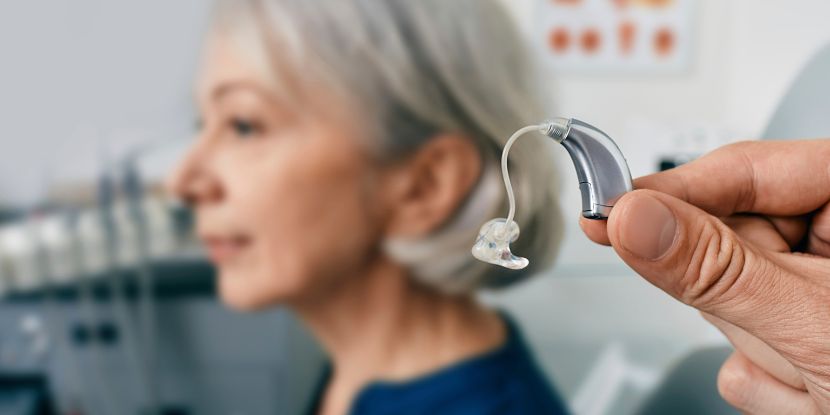
Hearing aid calibration is the process of adjusting and customising hearing aids to suit the specific hearing needs of each individual user. This adjustment is performed using specialised tools and software designed to measure and modify sound amplification levels according to the patient’s hearing loss.
Calibration is recommended when changes in sound quality, discomfort when using the hearing aid or difficulty hearing in noisy environments are detected. In addition, it is advisable to visit a professional at least once a year for a preventive check-up.
Benefits of calibrating hearing aids
Among the most prominent benefits of calibrating hearing aids, we find:
- Better speech understanding: Reduced distortion and improved clarity of sound.
- Improved comfort: Avoidance of loud or annoying sounds.
- Optimisation of performance: Makes the best use of the hearing aid technology.
- Adaptation to hearing changes: Hearing can change over time, so it is important to adjust hearing aids periodically.
Steps to calibrate hearing aids
The steps to properly calibrate your hearing aids and improve their performance are as follows:
Performing a hearing test
Before calibration, it is important to perform a complete hearing evaluation. This test allows you to find out the level of hearing loss and to detect which frequencies need further amplification. Without a pre-test, the hearing aid settings may not be appropriate, which will affect the perceived sound quality.
Adjustment via specialised software
Modern hearing aids have advanced technology that allows them to be set by specialised software at different frequencies, ensuring that the user can hear clearly in a variety of situations. This adjustment is personalised and tailored to the individual’s specific hearing loss.
Testing in different environments
Once the initial settings have been made, it is advisable to test the hearing instruments in different environments. Evaluating their performance in noisy environments, during conversations or in quiet spaces can help to detect if further modifications are needed. If the user experiences difficulty hearing in certain environments, additional adjustments can be made.
Customisation of manual settings
Some hearing instruments have the option to make manual settings via physical buttons or mobile applications. This allows you to modify the volume, change listening modes or activate features such as noise reduction. This customisation capability is useful for adapting to different scenarios without the need to visit a specialist.
Regular servicing and maintenance
Calibration of hearing aids is not a one-off process, but should be carried out regularly to maintain their effectiveness. Factors such as ageing, changes in hearing, poor maintenance or wear and tear of the device can affect its performance. It is important to have regular check-ups with a professional to make the necessary adjustments and ensure that your hearing aids continue to perform optimally.
At Audífonos Domínguez, we offer a specialised hearing aid calibration service to ensure that every patient enjoys clear and comfortable hearing. Our professionals make personalised adjustments using advanced technology, ensuring that hearing aids are perfectly adapted to individual hearing needs.
If you notice that your hearing aid is not working as well as before or you want to optimise its performance, visit our hearing centre in Malaga. Contact us and make sure you have quality hearing.