

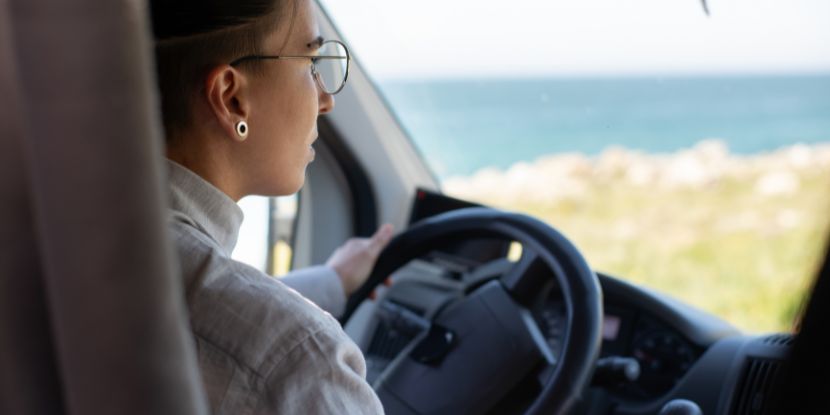
Driving is an activity that provides independence and mobility. For people with hearing loss, it’s natural to wonder whether they are able to drive safely and legally. Keep reading this article to find out.
Driving with hearing loss
People with hearing loss, whether partial or total, can legally drive in Spain. The law does not prohibit driving for those who were born deaf or who have lost hearing over time. However, certain medical and safety requirements must be met to ensure responsible driving. In many cases, visual ability and environmental awareness effectively compensate for the lack of hearing, allowing these individuals to navigate the roads without major difficulties.
That said, although there is no general prohibition, it is essential for the driver to be able to perceive key acoustic signals for road safety, such as ambulance, police, or fire truck sirens, as well as other vehicles’ horns in case of danger. For this reason, in some cases, the use of hearing aids or vehicle adaptations, such as additional mirrors, is recommended to ensure safe driving for both the driver and other road users.
Requirements for obtaining a license with hearing loss
People with hearing loss can obtain or renew their driver’s license, but they must undergo a series of mandatory medical evaluations to determine whether they meet the necessary conditions to drive safely.
Medical evaluation and hearing tests
The medical examination includes a tonal audiometry test, which measures the level of hearing loss in both ears. If the average loss is below 45%, the driver’s license is granted without restrictions. However, if it exceeds that percentage, a special license with certain conditions may be issued.
These conditions may include vehicle adaptations, such as wider or additional rear-view mirrors, and a limitation to driving vehicles in Group 1 (private cars and motorcycles). Driving Group 2 vehicles (trucks, buses, passenger transport, etc.) is not allowed, as they require more precise sensory perception.
In addition to hearing tests, the driver’s ability to communicate, follow instructions, and respond to emergencies is also considered. It is also important that the driver can correctly interpret visual signals from the environment as a way to compensate for the hearing loss.
Use of hearing aids while driving
If a person needs hearing aids to meet the minimum required hearing levels, they must use them while driving. This condition is reflected on the driver’s license through a specific code, and failure to comply may result in a violation.
Hearing aids must be in good condition and properly calibrated. Using them not only helps better detect environmental sounds — such as sirens, horns, or other vehicle engines — but also improves concentration and reduces the mental effort required while driving. In some cases, more frequent medical check-ups may be required to ensure that the hearing condition has not worsened over time.
Maintaining optimal hearing is essential for safe driving. At Audífonos Domínguez, we offer personalized hearing solutions that can significantly improve the driving experience for people with hearing loss. We provide high-quality hearing aids, tailored to individual needs, that allow drivers to better perceive acoustic signals from their surroundings, contributing to greater road safety.
If you live in Málaga and are experiencing hearing difficulties, contact us. Our team will advise you on the best hearing aid options in Málaga, ensuring that you can drive with confidence and in compliance with legal requirements.